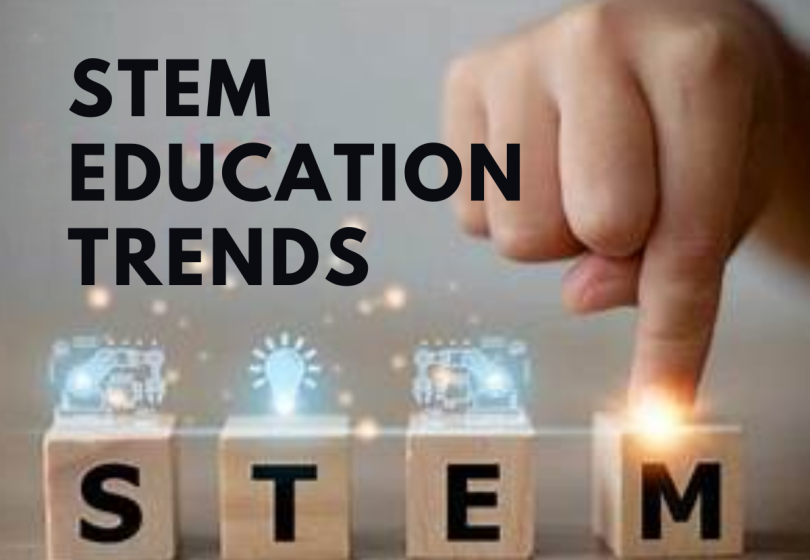

Have you noticed how the way we learn is rapidly changing? The shift is especially visible in STEM education—that’s Science, Technology, Engineering, and Mathematics.
These subjects are no longer confined to dusty textbooks or boring lectures. Instead, we’re seeing exciting transformations in how they’re taught and learned. If you’re a student, teacher, or parent trying to keep up, don’t worry—this article will walk you through the latest STEM education trends, their benefits, and even their drawbacks, all in a friendly, easy-to-follow way.
🌐 What Are STEM Education Trends?

STEM education trends are modern strategies, tools, and philosophies used to teach science and technology in more engaging, relevant, and practical ways. These trends are being shaped by today’s needs—like the demand for tech-savvy workers, climate change, and even AI.
Let’s dive into the key trends one by one.
🔍 Top STEM Education Trends in 2025
1. AI, Machine Learning & Robotics in the Classroom
Artificial Intelligence and robotics are no longer just futuristic buzzwords—they’re active parts of school curriculums. From coding AI chatbots to building small robots using kits like Arduino or Raspberry Pi, students are learning not just how to use technology, but how to create it.
Why it matters:
It teaches kids how algorithms work, how machines learn, and introduces logical problem-solving from an early age.
2. Project-Based & Inquiry-Based Learning (PBL & IBL)
Instead of memorizing equations, students now solve real-world problems. This can be anything from creating a smart irrigation system to developing a mobile health app. They learn through doing, not just reading.
Why it matters:
PBL makes learning active rather than passive, boosting student engagement and comprehension.
3. Virtual Reality (VR), Augmented Reality (AR), and Simulations
Imagine walking through an ancient rainforest or exploring the inside of a volcano—all while sitting in a classroom. Tools like VR headsets and AR apps bring abstract STEM concepts to life.
Why it matters:
Helps visual learners grasp complex topics like anatomy, physics, and astronomy in a way that’s fun and memorable.
4. Personalized and Adaptive Learning
Platforms now use AI to track how students learn best—fast or slow, visual or textual—and adjust lessons accordingly. Platforms like Khan Academy and Google Classroom are integrating adaptive tools.
Why it matters:
No two students learn the same way. Adaptive learning makes education more inclusive and efficient.
5. STEM for Girls & Underrepresented Groups
The STEM world used to be male-dominated. Thankfully, this is changing. Many organizations and schools are introducing programs that encourage girls, minorities, and differently-abled students to explore STEM careers.
Why it matters:
More diversity = more innovation. Different perspectives lead to better ideas and solutions.
6. Environmental STEM (Green STEM)
With climate change becoming a critical issue, schools are integrating eco-conscious learning into STEM. Students work on solar power models, recycling systems, and water purification projects.
Why it matters:
Promotes responsibility and prepares students to tackle real environmental challenges.
7. Industry & Career Integration
Schools are collaborating more with industries. High schoolers now do internships in tech companies, attend coding bootcamps, or join startup incubators. Certifications in fields like cybersecurity, app development, or AI are also being offered.
Why it matters:
Prepares students not just for exams, but for real jobs with marketable skills.
You may also like to read these posts:
Healthy Living Tips: A Complete Guide to a Better You
Latest Fashion Trends: Your 2025 Style Guide
Wellness and Self-Care: A Complete Guide to a Healthier You
Travel and Leisure Ideas — Your Expanded, Friendly Guide
✅ Benefits of STEM Education Trends
Let’s take a deeper look at why these trends are beneficial:
1. Prepares Students for Future Jobs
STEM careers are booming—from data science and AI to renewable energy and healthcare tech. These trends help students gain skills employers are looking for.
2. Encourages Problem Solving and Creativity
Instead of following step-by-step instructions, students experiment, fail, try again, and eventually succeed. This builds resilience and creative thinking.
3. Increases Engagement
Hands-on projects, virtual field trips, and gamified lessons make students want to learn. This reduces dropout rates and improves academic performance.
4. Fosters Teamwork and Collaboration
Many STEM activities require group work, helping students develop communication and social skills.
5. Promotes Inclusion and Equity
With personalized tools and outreach programs, more students—regardless of gender, race, or income—can access quality STEM education.
❌ Drawbacks of STEM Education Trends
Of course, no system is perfect. Here are some challenges:
1. Technology Gaps
Not every school has the funding to buy VR headsets, robotics kits, or AI tools. This creates a digital divide, especially in rural or low-income areas.
2. Teacher Training Shortages
Many teachers struggle to keep up with the pace of change. Lack of professional development can make new tools hard to implement.
3. Too Much Tech, Not Enough Humanity
In the race to go digital, subjects like literature, art, and emotional learning may get less attention, which could affect well-rounded development.
4. Assessment Challenges
Standardized tests don’t always capture the creativity and innovation that STEM encourages. Schools need better ways to evaluate student performance.
5. Curriculum Overload
Trying to add every trendy topic—AI, VR, coding, sustainability—can overwhelm both teachers and students if not carefully managed.
🧠 Final Thoughts
STEM education trends are revolutionizing the way we learn. From AI-powered lessons to eco-friendly projects, the focus is now on real-world skills, creativity, and inclusivity. While there are challenges to overcome—like funding gaps and over-reliance on tech—the future looks promising.
If we continue to adapt and innovate, we’ll empower the next generation to not only survive in the 21st century but thrive.
🙋♀️ FAQS
Q1. What exactly is STEM education, and why is it important?
A: STEM stands for Science, Technology, Engineering, and Mathematics. It’s important because these subjects are the foundation of today’s most in-demand jobs and innovations—like artificial intelligence, medicine, clean energy, and space exploration. STEM education teaches students not just facts, but how to think critically, solve real-world problems, and work creatively.
Q2. What are some of the most exciting STEM education trends in 2025?
A: The top trends include:
Use of AI and robotics in the classroom
Project-based learning (students learn by doing)
Tools like VR/AR simulations for interactive learning
Personalized and adaptive learning software
More focus on diversity and inclusion in STEM
Integration of environmental sustainability
Stronger ties between education and career skills
Q3. At what age should children start learning STEM?
A: Believe it or not, STEM learning can begin as early as preschool! Simple activities like building with blocks, asking “why” questions, playing with magnets, or basic coding games help develop curiosity, logic, and problem-solving skills early on.
Q4. How is technology like AI and VR used in STEM education?
A: AI is used in adaptive learning platforms to personalize lessons based on a student’s strengths and weaknesses. Virtual Reality (VR) lets students explore the solar system, human body, or historical events in a 360° environment—making complex concepts easier to understand and more fun to learn.
Q5. Are arts and creativity a part of STEM?
A: Yes! That’s where STEAM comes in—adding the “A” for Arts to STEM. This approach recognizes that creativity, design, and innovation go hand-in-hand with science and tech. For example, designing a product requires both engineering and artistic thinking.